Tuesday, February 28, 2017

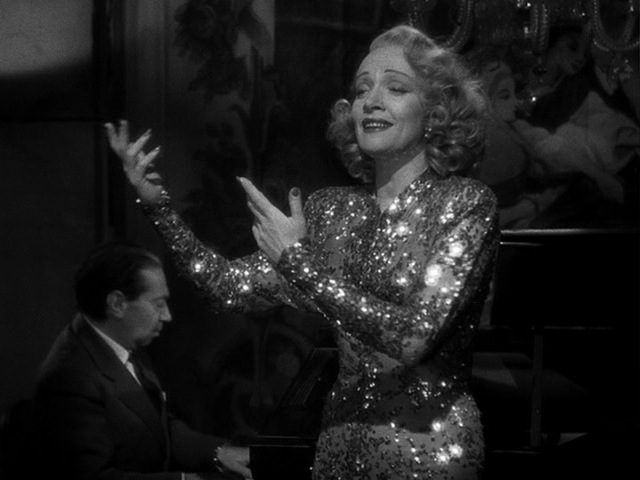
A Foreign Affair- (1948) Dir- Billy Wilder


What I remember:


Another discovery from my college years, "A Foreign Affair" was probably the 6th or 7th Wilder film I'd seen. I had never heard of it, and none of the great Hollywood or New York critics ever mentioned it. I was already a big fan of the little Austrian's work; particularly "Some Like It Hot" and "Double Indemnity". Guessing that it's lack of inclusion in the pantheons of my trusted critics of the time (Kael, Canby) was due to it being the lesser work of a cherished auteur, I had lowered expectations. 

To say that I was astonished by just how unique and powerful this film was would be a gross understatement. Just that opening sequence alone, with the Congressmen arriving in Berlin and seeing the devastation, seemed so frank, so much like a documentary. It was simply not a common thing in a Hollywood production of the day. Wilder's connection to Central Europe was evident. He was one of Tinseltown's refugee corps, along with his mentor Ernst Lubitsch, Fritz Lang and so many others; Jews who got out before the ghettoes and the camps. And yet, the Continent still called out to them. 

Wilder's cynicism was never so evident as in "A Foreign Affair". Captain Pringle's relationship with Erika Von Schluetow is a symbiotic mess of self service; his romancing of Rep. Phoebe Frost is even worse. The two GI's who are blatantly trading chocolates for sex with young starving frauleins are simply reprehensible. 

Somehow all this bad behavior and postwar horror gets wrapped around a delightfully funny romantic comedy. At the center of it are two brilliant performances by the great Jean Arthur and the stunning Marlene Dietrich. There is nothing like "A Foreign Affair", and I doubt we will ever see it's like again. 

After re-watching:

“If you give a hungry man a loaf of bread, that's democracy, if you leave the wrapper on, that's imperialism.”— Congressman Pennicott

PLOT SUMMARY

Priggish Congresswoman Phoebe Frost (Jean Arthur) is part of a delegation sent to monitor the morale of American soldiers in postwar Berlin. Upon arrival, the devastation and depravity of the situation is immediately apparent. Complicating matters is the presence of Captain John Pringle (John Lund), who is an Iowan like Frost, but has succumbed to the postwar atmosphere. His affair with a local chanteuse (Marlene Dietrich) who was once the paramour to a Nazi bigwig, is a compromising position that he must hide from the committee. 


STORY/THEME

The main reason why you’ve probably never seen this film is that it was somewhat quashed by both it’s studio, Paramount, and then years later by some television stations that could have shown it. It’s depiction of American Servicemen was deemed offensive, casting a negative pall on our heroes. Yet the film itself makes the point that these men were recovering just as much as the continent they occupied. War unleashes an animalistic tendency in mankind, and it is not just limited to violence. So we can look away when necessary if our boys take advantage of the situation by parlaying their candy and cigarette rations into some action of the sexual kind.

Don’t get me wrong. I am not condoning the coercion into prostitution of women in a desperate situation. Yet that was the reality of postwar Berlin, and I applaud Billy Wilder for showing it in stark realism. “A Foreign Affair” came out the same year as “Bicycle Thieves”, the bell-weather of Italian neo-realism about a desperate father and his child in postwar ravaged Rome. 

I was correct in recalling that “A Foreign Affair” seems on the surface to be a typical romantic comedy, but Wilder’s use of real footage shot in Berlin as rear projection for most of his Hollywood-shot scenes adds a sense of documentary to the proceedings.These shots don't look much different than the current video we see of Syrian cities that have been pretty much leveled.

Wilder’s contempt for the Germans is also very evident. “They burned most of my family in their damned ovens!” he has been quoted as screaming. “I hope they burn in hell!” The way he has the bureaucrats and wait staff sucking up to ex-Nazi honchos despite the new order is his little reminder that, yes, you may feel sorry for these people going through this nightmare, but let’s remember that this punishment is about half of what they really deserve. 

The question now arises, does this juxtaposition work? Do the filmmakers pull off the realistic rom-com, do they make it entertaining, and also believable? Do they help us to understand the issues our servicemen had to deal with in the rubble of a once great city? I think a resounding “yes” is in order. Of course, in tone it is nowhere near as close to a documentary as “Bicycle Thieves”, and that is by design.

FILMMAKING

Our spoiled contemporary eyes are used to digital effects beyond our wildest dreams, and also spare-no-expense film budgets that allow location filming in incredibly remote and/or spectacular places. A film like this, with so many rear projection scenes, looks so incredibly fake nowadays. If you can get past that bias, try to imagine what it must have looked like back in the 1940’s. Wilder couldn’t really shoot the dramatic scenes in Berlin, the cost would have been prohibitive. Considering these limitations, it is a fantastic job of combining the footage of the ruins with the studio reels. 

As always, Wilder will throw in brilliant little jokes for the benefit of the hipper audiences. As Pringle drives through the rubble to visit Erica in her crumbling apartment, he is whistling “Isn’t It Romantic”. The score even picks up the theme. This isn’t exactly like being on a gondola in the moonlight! 

Whistling is a nice leitmotif throughout the film; we know Pringle is starting to fall in love with Frost when he is whistling “Shine On Harvest Moon”, an "American as apple pie" standard. 

Wilder also has Colonel Plummer (Millard Mitchell) sporting a physical tic; when perplexed, he rubs the side of his nose with his middle finger. A few times it does look like he is flipping people off. The timing of these gestures are hilarious. 

Wilder and Arthur combined beautifully to portray the methodical Frost and her transformation from stick-up-the-ass bureaucrat to besotted teen. In the opening scene, the congressmen are gawking from their plane at the bombed out city, and when one of them beckons Frost to come look, she anally puts away her writing and notes, placing bags within bags, the camera staying with her to the annoyance of the audience. Oh my God, you say to yourself, just get up and look, woman!
Later when she has fallen for Pringle, she literally floats up the stairs to her room. 

Lighting plays a huge factor, not just in the narrative but also as a character enhancer. Dietrich is lit like a movie star for most of the film; her natural glamour is luminous. Arthur is lit like all the men, that is, until she falls in love. Suddenly, focus grows softer, her eyes shine, her lips seem fuller. It’s not terribly subtle, but it is effective. 

Wilder’s choice to use Friederich Hollaender as composer and accompanist for Dietrich’s songs was beyond inspired. The composer of the songs for Von Sternberg’s “Blue Angel” returns with some great Cabaret music for the nightclub scenes. The best is “Black Market”, sung in English, and acted to perfection by the great chanteuse. The lyric captures the desperation in Berlin:

“I’ll trade you for your candy, some gorgeous merchandise
My camera, it’s a dandy! Six by nine, just your size!”

Soon the lyrics start to suggest the market that’s at the heart of the film…the flesh market:

“Come and see my little music box today
Price? Only six cartons. Want to hear it play?”
“I’ve got so many toys,
Don’t be bashful, step up, boys!”

1948, people! This is advanced, mature and risqué to say the least. We have come to expect nothing less from this genius.

Another song, “The Ruins of Berlin” has a perfectly timed line sung by Erica as her former lover, Nazi big wheel Hans Otto Birgel, appears from the shadows of the club while she croons “They won’t return, the phantoms of the past”. Just brilliant!

PERFORMANCES

Dietrich is always herself, and we love watching her. She is hyper-sexual, with her deep voice, swaying hips, high cheekbones and sleepy eyes all in contribution. 
She never hid from the press or public just how liberated she was. I think the joke goes: She was a tri-sexual. She’d try anything.

Wilder’s adoration of Marlene is apparent from her first scene, when she is madly brushing her teeth, while Pringle waits to show her the booty he has brought. He makes fun of her, and she turns and spits the toothpaste in his face! In one quick moment, she shows us that Pringle may think he’s in control, but she is calling the shots. She does not look glamorous yet, but you can tell it’s coming. 
When you see her next, she is singing in the club, and it’s simply riveting. As she sing-speaks the lyrics, her face and body movements tell the story in complete harmony. Nobody did this as well. This is the true definition of a movie star; she dominates the screen whenever she is on it, no matter who is opposite her.

I have always been a big fan of Jean Arthur, from her work with Frank Capra through her role as Calamity Jane to this movie. My understanding is that she would get so worked up that she'd vomit before filming every big scene. This is probably a stretch, but I like the idea of that kind of commitment! I think I’ll try that before every big concert. 

Naw, I think my habit of napping before the show sounds like more fun.

Arthur has a knack of making the most dichotomous characters seem real, and this talent helps her enormously in “A Foreign Affair”. There isn’t a moment when I find her transformation false, and in lesser hands it really could have been a disaster. There’s a great shot of her, when she finds out that Pringle is still carrying on with Erica, and Wilder has her profile in silhouette. You can’t see her face, but just the angle of her head fills you with sorrow for her. At 47, she could still embody all the emotions of a teen crush. 


Unfortunately, she is given one terrible line at the end; “For all my headaches, you’ll be my aspirin”. It’s awful, and they should have cut it from the movie. The rest of the script is so strong, they can be forgiven for that one misstep.

Lund, as the acute angle of the triangle, does his best. He’s not immensely talented, but he fills the role well. Yes, Cary Grant would have been better, but he was not available. Lund does “smarmy” well, and is convincing enough as a liar to sweep Frost off of her feet. 

Millard Mitchell’s Col. Plummer has much of the best dialogue throughout; in particular his tough guy narration for the congressmen as they tour the ruins is on point. It’s as much for the American audience’s sake as it is for the characters. Many of them had no clue just how devastated Germany had become, and some might feel guilty. He makes sure that you remember why we had to do this, and that these are just desserts.

ON SECOND LOOK

OK, full disclosure…this was more like 5th or 6th look, but I really wanted to share my love for this unheralded masterpiece. Catch it if you can on TCM. I believe it’s in a regular rotation. You won’t be sorry. 

On First Look: ✭✭✭✭      On Second Look: ✭✭✭✭

Tuesday, November 29, 2016

“Brainstorm” (1983) Dir: Douglas Trumbull


What I remember:

Without a doubt, “Brainstorm” was a prescient movie. I recall that the plot hinged on the invention of headgear that allows one to record full experiences; sight, smell, sound, feeling, taste. Then another person can replay this “tape” and relive that exact experience. The development of “Google Glass”, Smart Glasses and other similar devices proves just how visionary this was.

 I felt that the subject matter that this movie tackled was also very forward-looking. The idea that virtual reality could actually supersede true experience seemed in 1983 to be more science fantasy than predictive fiction. Nowadays it’s happening in every possible phase of existence. 
Virtual experience has permeated entertainment, business, sports, sex and even warfare. 

Famously, “Brainstorm” is NOT remembered for all this fascinating stuff, but instead for the death of it’s female lead during filming. The circumstances of Natalie Wood’s drowning were mysterious, and whether foul play was indicated has been debated but never proven. Her husband, actor Robert Wagner, was implicated by the Hollywood press, who, as we are all aware, are constantly in search of a scandal. It turned out that many years later, the boat’s Captain recounted his testimony, and interest in Wagner’s guilt waxed. 

That is a story for a different blog, however. I am mostly interested in how Wood’s tragic death affected the cast and crew, and of course the actually shooting of the scenes she may have had left. By most accounts, all major scenes with Wood had been completed by the time of her drowning. Yet one must assume that her death had a negative effect on everything and everyone connected to the production. How could it not?

Yet I still hold “Brainstorm” in very high esteem, thanks to its scarily accurate foresight, brilliant effects, and profound subject matter. 

Oh right….and the chance to see Christopher Walken act like a normal person. 


After re-watching:

“All my life, I never needed anybody... And now, because of this thing she left me, I'm scared. For the first time in my life, I'm scared. But the thing is, I like it. I want more. You're married to a man who has a chance to take a scientific look at the scariest thing people ever have to face. I've gotta do this... gotta play that tape, and you gotta help me.” Dr. Michael Brace


PLOT SUMMARY

Dr. Michael Brace (Christopher Walken) and Dr. Lillian Reynolds (Louise Fletcher) have developed a brand new experiential medium, one in which a headset can transmit all 5 senses from one person to another. Their work has excited the board members of the company they work for, and particularly their CEO Alex Terson (Cliff Robertson). As they continue to experiment more, they find that memories can also be transmitted. Brace uses these to mend his relationship with his estranged wife Karen (Natalie Wood), and we can see the upside of this technology past the obvious entertainment factor. However, the military is also interested in using this invention for other means—including missile guidance and torture. 


STORY/THEME

We are definitely not there yet. We may be close, but the kind of things these folks are doing are still way beyond our technology here in 2016, 33 years after the release of this film. Sight and sound is no problem, of course. We’ve had that ability since the sound camera was invented. But the sensations? The memories? The taste and smell of things? The emotions? Nope.

There is much that is fascinating about “Brainstorm”. The concept that you can bring a broken couple back together by having them literally relive the best parts of their relationship is kind of a pipe dream, though. Once a flame dies, it can never be reignited in the same way. Still, this method might be a lot more effective than couples counseling!
    The funny thing is, I find that my memories of events are always romanticized way past the actual reality of them. So maybe reliving something fun or romantic might not actually live up to what you have constructed of it from memory. 

HEY——WAIT A GODDAM SECOND! Isn’t that what I am doing with this blog? Has this thing come full circle? Yogi….is this deja vu all over again? The point herein is that at my age I am far from the same person I was when I first saw these movies. Times have changed; I have changed! Couples who have been through the entire arc of a relationship are changed forever, so I doubt that Project Brainstorm would save a disintegrated marriage.


Yet when (SPOILER) Dr. Reynolds has a cardiac and records the actual experience of dying, the full potential of this technology becomes apparent. The tape runs for minutes after she “crosses over”, and if you can experience this without actually having the symptoms of a heart attack, then you might answer the big one. You see why I found this film so compelling! 

We also come to that part of the story wherein the new technology is used for nefarious means. Imagine—-we could torture someone and cause no actual damage to them. OK, so any of us who have listened to Paul McCartney’s “Simply Having a Wonderful Christmastime” know what that is like. 
      Seriously, think of how agonizing actually living through an endless full-on heart attack would be…
Yes, you can have my SS number and address. Yes all of my friends are card carrying members of Al Qaeda. Yes I was responsible for 9/11 and JFK’s assassination and “Jupiter Ascending” and Pitbull. Guilty as charged. Just make it stop, please. 


FILMMAKING

It’s curious how some movies that predict the future and our future technology just become laughable when that future arrives and they completely missed it. Others miss, but still look and feel pretty authentic (“2001: A Space Odyssey”), and some hit it right on the nose (“Idiocracy”- need I say more?). In “Brainstorm”, the future has a few real swings and misses:
  1. The center of all US high tech development would be the Research Triangle of North Carolina. As we now know, it is McCann's Irish Bar on 49th and 8th in New York. Ok...I keeed. It's in Silicon Valley. 
  2. We would still use tape to record things. Even back then in 1983 people were talking about the use of chips and compression for storage. It’s most jarring when someone in the movie actually splices the tape using an edit block and scissors!
  3. There would be less traffic, wherein rush hour would consist of one guy on a recumbent bike. Need I comment? Also the cars in this film are all late ’70’s clunkers. Wasn’t THAT in the budget?
  4. People would still be chain smoking at the office. Well, it does take place in North Carolina, so we need to give them a pass on that one.

Douglas Trumbull had made his name in Hollywood in the world of special effects. His resume includes some of the greatest and most innovative films of the genre, including “2001”, “Close Encounters”, “Blade Runner” and “Star Trek; The Motion Picture”. 

He gets so many things right in “Brainstorm”, and so many things wrong. The tension in certain scenes is squirmy good. I’m thinking in particular the death scene of Lillian Reynolds, and the moment when the Braces’ son puts on headgear not aware that he will be experiencing the world through a paranoid schizophrenic. However, in the latter sequence, Trumbull glosses over this quickly, the boy never reacting to the experience as a mad person would. Afterwards, you don’t see him disturbed, you merely hear about it from the doctors. In fact, other than the heart attack, many of the punches are pulled. If this film were remade, that would be the first change made; the audience would have to experience in full intensity the horrors and pleasures of this technology.

Trumbull uses convex lens to give the audience the sense that they are viewing things through the headgear, and then drops that pretense near the end. That’s weird and unsettling. He also has something akin to a TV test pattern to start the film during credits, which you later realize is the first transmission between people; one looking at the pattern, the other seeing it via the headgear. 
Really? Whose idea was that? A few minutes later, the transmitting person eats a bizarre combo of foods that our receiver correctly identifies. But since this is a full sensory transmission, why couldn’t the receiver hear and see what was being ingested? 

Overall the effects are well done as you would expect. Yet there is nothing transformative, nothing that sticks out as totally fresh and different the way his previous work had. I’m thinking of stuff like “The Infinite and Beyond” sequence in “2001”, or the amazing (if incredibly slow-paced) effects in “Star Trek”. 

Probably the worst scene comes at the climax, when the Braces have rigged the lab for chaos in order for Michael to experience the full length of Lillian’s crossing over tape. This sequence turns into a bad slapstick comedy with security officers facing off against robot arms and slipping on ball bearings, with soap suds everywhere. At another time in the film, it would have been fine, but at this point we are trying to find out the meaning of LIFE and DEATH, for Pete’s sake!!! 

The last 30 minutes of the film feel like that last part of the roller coaster, after the big drop and the crazy loops, when you have already had your thrills and are now wondering when it will stop. 

PERFORMANCES

As Michael, Walken has his moments of Walken-ness, but they are thankfully few and far between. We are supposed to believe that he is a scientist, a calm and thoroughly reasonable soul. In one scene, he goes full on confrontational and we get to see the real Christopher. It’s perfectly utilized and fully believable when you understand that it is an act. So, yes— Christopher Walken has range. Or at least HAD range. 

Natalie Wood’s portrayal of Karen shows some roundness of character. She is part of the design team, and has to work with her estranged husband. She is the calmer of the two (shocker), but shows much passion when they reconcile. I don’t really see any effect of her death on the portrayal….it seems that all of her scenes that should have been in there are there. It’s not a terribly meaty part, but she plays it with full conviction. 

Louise Fletcher was 8 years removed from her Oscar winning achievement as Nurse Ratched in “One Flew Over the Cuckoo’s Nest”. The interim was not a series of great roles, sadly. When this part came around, she ran with it, and is the real reason other than the actual theme of “Brainstorm” to watch the movie. She is back in form, with a very convincing turn as the chain-smoking scientist who hates that her breakthrough will be used for something nefarious. Early on, she is poorly served by some bad continuity, wherein she lights about 4 cigarettes in a 2 minute span. I know they are trying to show why she would sustain a heart attack at such a young age, but really? Some comments I read complained about her death scene, but I felt it was superb. 

The supporting cast, headed by a slick Cliff Robertson as the caring (but not really) CEO is all excellent. You would think that a guy like Trumbull who has worked more with green screens and animations and the like would be ill-suited to direct acting, but ironically I feel the performances are overall much better than the effects!

ON SECOND LOOK

Did Wood’s death negatively affect this film? Only the cast and crew can tell us that. I will say that the last part of it is a shambles, so depending on how it was shot, the answer could be “yes”. “Brainstorm” isn’t a bad film, in fact it’s a very compelling movie with some profound issues at its heart. Oddly, the things you would think would be its strength: effects, suspense, technique— are all a bit disappointing. What does come across well are the originality of it’s story, the lead performances, and the quick pacing. In retrospect, maybe the pacing is the problem…important moments are quickly glossed over and disposed with, dulling the impact of the overall experience. 

On First Look: ✭✭✭1/2      On Second Look: ✭✭1/2

Wednesday, August 17, 2016

"A Thousand Clowns” (1965) Dir: Fred Coe


What I remember:

Uhhhhhhh……thinking. Hmmmm….

OOH- here’s one!----Jason Robards screaming at his neighbors to wash their windows.
And another!---Barry Gordon being very precocious. More memories are coming in from the recesses:

New York City in the 60’s. Some funny bits. Single father or something like that and an only child. A pretty major celebration/condemnation of eccentricity. A social worker trying to make them conform to societal norms. 

Come ON, people! It’s been easily 50 years since I saw this. OK, maybe more like 47 or 48 years. Yet somehow I think about it maybe once a month or so. I could not tell you why, because I can barely remember a plot, much less any lines from the movie. But there was something about that relationship between Murray and Nick that rang true to me, and that I kind of gravitated towards. The idea that a single father and his son could live together and create their own wacky world of logic and rules was pretty compelling to young Wayne. 

Don’t get me wrong, it’s not like my family was this Donna Reed/Leave it to Beaver kind of mainstream suburban pap. Ohhhh, far from it! But we certainly didn’t have the kind of fun, the kind of crazy Marx Brothers-like anti-establishment zaniness that Murray and Nick in “A Thousand Clowns” seemed to have. That kind of stuff doesn’t happen when there is a Mom around. Funny thing is, after my parents divorce, the times me and my sister spent with our single father (until he remarried) seemed more like episodes from “Burke’s Law” than “Duck Soup”. He played the part of the single, handsome lawyer, and for a 10 year old that was almost as boring as “Father Know’s Best”. We took some cool trips, and he had some good-looking girlfriends, but I was too young to appreciate either. 

SO…I became kind of obsessed with this movie after seeing it in the theater, and then maybe a few more times on TV.
It has been pretty hard to find, but finally while scanning the TCM playlist there it was!  
Now that I have raised my own child (but not solo, thank GOD), maybe the film will mean something entirely different to me. 

After re-watching:

“Irving R. Feldman's birthday is my own personal national holiday. I did not open it up for the public. He is proprietor of perhaps the most distinguished kosher delicatessen in our neighborhood, and, as such, I hold the day of his birth in reverence.” Murray Burns

PLOT SUMMARY

Murray Burns (Jason Robards) has been in charge of his 12 year old nephew, Nick (Barry Gordon) for 7 years, since his sister dropped him off and left. Murray is an eccentric, who eschews the normal day to day life, and chooses to remain unemployed. Somehow he and Nick stay fed and sheltered, and Nick remains at a top school in New York City due to his advanced intellect. Their somewhat idyllic relationship has it’s strains, in that Nick would like for Murray to get a job. This becomes imperative when social workers sent by Nick’s school recommend that Nick be given to a foster care family, unless Murray can prove responsibility by re-joining the rat race. 

STORY/THEME

New York City in the ’60’s. What a rush of memories watching this film conjured up for me. This is much closer to how I remember things than that fluffy “How To Murder Your Wife”, or even “Mad Men”. 

I knew some adults like Murray, but they mostly spent their time at the racetrack. Those guys were not bums, but just different than the usual folks who did the 9 to 5. I also knew a lot of people in the entertainment field and the entertaining (hotel/restaurant) field. Everybody worked their asses off. Nobody spent all day like Murray; floating around town, visiting the landmarks, yelling at buildings and sending off Ocean Liners for imaginary friends. Do that, and soon you get evicted and find yourself living in a shelter or under Grand Central Station in the catacombs, eating your dinner out of a garbage can. This is New York City, and we don’t suffer lazy bums gladly.

Yet this is the person we are supposed to admire. Now give him the added responsibility of raising a child, and the tale becomes simply unbelievable. I guess we are supposed to believe he’s living off unemployment insurance and his savings. That is never made clear. At one point, Murray congratulates a female neighbor with “Wonderful..three months!” Sandy (his girlfriend) asks him if the woman is pregnant, and he goes “No…on unemployment!”

The real theme of course is the child/adult caring for the adult/child or vice versa. For that reason we can swallow the whole issue of sustenance and get on with the story. There is a wonderful charm to the relationship between Murray and Nick, and there were times I wished we saw more of it, and less of the other adult characters. When the two are together doing their bits, it feels funny and natural. 

Obviously, this can’t go on forever. At some point Murray will have to go to work. And it’s not like his work is an odious desk job at Cogswell Cogs or some other nasty worker bee drabness. For God’s sake, the man is a writer for children’s TV. OK, it may not be like being James Bond or something, but it seems like a pretty fun way to spend your time if you are a grade A cut-up and all-around loose cannon.
Awww, poor Murray. He’ll have to suffer writing dumb jokes for kids and working for an insufferable jerk like Leo Herman, aka Chuckles the Chipmunk. I know a lot of people who would kill for that job. 

Is it a real conflict, then? Is it really so awful that he change his ways and join society and earn his way in the world? The conversation he has with his brother near the end of the film is where the meat of this story can be found. It’s almost an inverse version of “Amadeus”. The man who is mediocre celebrates his mediocrity, and the eccentric balks, but eventually comes around. I think the point made is, that this world offers you multiple paths towards happiness. You must decide at some point which path is yours. Or, you might have that path forced upon you, and you might still find happiness in that direction. One thing we know, many eccentrics and iconoclasts find their way in society one way or another. And if you care for and about your family, you make the necessary compromises.

FILMMAKING

“A Thousand Clowns” is so obviously a film adaptation of a stage play. It struggles mightily with the process of expanding outside of the one room flat inhabited by Murray and Nick. Director Fred Coe and Playwright Herb Gardner were responsible for the Broadway play, and went ahead with the film adaptation together. 

The film starts with a desolate NYC street, and Murray yelling at the inhabitants as I recalled correctly. It is 7:15, and the streets are silent, but then at the snap of Murray’s fingers, the morning commute begins and so does the title sequence in a pretty cool montage of real life Manhattan shots, complete with a blaring marching band doing John Phillip Sousa.

As soon as the titles conclude, we have the messiest sequence you can imagine, with a dialogue between Murray and Nick and shots of them wandering around many recognizable city spots, the Williamsburg Bridge, Central Park, Childs Restaurant. The dialogue continues, even though the venues change abruptly, and many times you can see their mouths not moving at all. 180 degree rules are obliterated, and the sound mixing is awful. It’s all very amateurish, and reeks of people with no film pedigree whatsoever. 

Finally we return to the one room apartment and order is restored, thank goodness. The flat is filled with junk, including about 20 clocks all showing a different time. When social workers Arnold and Sandy, arrive, we have a double conflict, one between Murray and Nick, with Nick trying to impress Arnold and Sandy, and Murray antagonizing them. The secondary conflict is between Arnold and Sandy themselves, as the two try to fight through their Male dominated relationship that is both professional and personal. 
It’s a well acted, interestingly complex dynamic. 

So this is exactly how the film progresses. When inside the apartment, things are wonderful. As soon as we venture outside, not so much. It never really gets as bad as that post title montage again, but the sequence with Murray romancing Sandy gets pretty close. 

Conclusion? Folks raised in the theater need to make theatrical films. Folks known for cinema need to make image-rich, visually oriented movies. Sure there are exceptions. But even the best of them, say Hitchcock’s “Rope”, still had to have some stylistic quirks to make the director comfortable. (in the case of “Rope”, it was no cuts).  

I will say that the outside sequences, while pretty much a monstrosity, must have been influential—— I saw a lot of stuff that reminded me of similar sections of “Harold and Maude”, “The Stunt Man”, and a ton of Altman films. 

The film was shot by Hollywood and WWII veteran Arthur Ornitz, who has many wonderfully shot films to his credit, with titles like “Requiem for a Heavyweight” and “Serpico”. I can only blame how “A Thousand Clowns” looks on Fred Coe. It’s not easy to watch.  
As for the music, what can I say. Blaring marches, dixieland versions of Sousa, and our two main characters doing a ragtime version of “Yessir, That’s My Baby” are about all we have. The sound editing and mixing is beyond amateurish. I guess this is what real low-budget looked like in the ’60’s. Don Walker was nominated for an Oscar for the music. What the hell?

PERFORMANCES

Here is where things take a nice turn. The entire cast is phenomenal, starting with Robards. Having been a TV and Broadway actor for years, his first major film role was as Jamie Tyrone in Sidney Lumet’s version of “Long Day’s Journey Into Night”. This was made for TV, but with stars like Kate Hepburn and Ralph Richardson was elevated to filmdom. Jason’s turn in “A Thousand Clowns” is pretty much perfect. He was recreating his Broadway role, so he knew exactly what worked, I’m sure. He goes from puerile to mature, from charming to obnoxious, from brusque to tender with confidence and ease. 
Co-star Barry Gordon was 16 years old when he played 12 year old Nick, but his pre-pubescent voice and size come across very authentic. He has one very intense scene late in the film with Leo Herman (Gene Saks) that shows just how mature an actor Gordon was at that point. Saks is hysterically funny as Herman/Chuckles, and I can see exactly why I loved the movie as an 11 year old. He makes a mockery of the TV kid’s show star, doing unfunny schtick and being insulted when Nick doesn’t get it. Nick’s monologue explaining why the Chuckles bit wasn’t funny is a powerful centerpiece of the film; he shows us exactly why Murray has been such a great father figure to him despite all of Murray’s shortcomings. 

Barbara Harris has a meaty part, and she handles it as beautifully as everything I’ve seen her in. It was her feature film debut, but she had done much theater as a member of the Actor’s Studio. She is remarkably believable as a scientific straight-laced young professional romanced by the charming nudnik. As the other social worker,  Larchmont lock-jawed William Daniels does his typical fastidious, officious routine to a tee. 

A best supporting actor Oscar was awarded to Martin Balsam for his portrayal of Arnold Burns, the talent agent brother of Murray. It’s a mostly unmemorable role, with one very important scene that I referenced earlier. I’m a huge fan of Martin’s, and always loved his role in “Little Big Man” as the huckster who keeps losing parts of his body. He should have won for THAT role, not this.
The supporting actor award really should have gone to Gene Saks, who is by far the one consistently funny thing about this film. Until I watched it, I had no idea that a phrase I say A LOT (usually in reference to an empty club I am performing at) comes from Saks’ Leo Herman; “Dead, dying, death, doornail dying death.” This is in reference to his studio audience of children unenthusiastically yelling ‘yay” at his bidding. His frantic scene with Nick is the best thing in the movie. 


ON SECOND LOOK

Now that I understand what I loved about this movie as a kid- Chuckles The Chipmunk- I can see that it’s flawed, amateurish filmmaking way undercuts what was probably a great experience at the theater. The film tries too hard to be cinematic, but our director just didn’t have the chops to pull it off. He also probably didn’t have the budget. I don’t think I missed the depth of the message due to being 10 years old. If anything, I got it then just as clearly as I get it now:
Responsibilty sucks. Love does not. Sadly, the two go hand in hand. 

On First Look: ✭✭✭1/2      On Second Look: ✭✭1/2

Tuesday, June 14, 2016

"The Lookout" (2007) Dir: Scott Frank


What I Remember:

“The Lookout” will be my most recent film re-watched in this series. I should have a pretty good idea of what it was about. 

Since this entire blog is about how memory serves, I wonder how well I recall this movie! I mean it's only been 10 years, right? OK, but in all candor I am now the guy who goes up to the kitchen from my basement studio about 38 times a day to do something, and when I get to the kitchen I have completely forgotten what that was. At this point I head back down to the studio to see if something down there jogs the old grey matter. When it does, I am back upstairs and the whole process repeats itself. 

I call this " The Geezer Stairmaster".

This was a film I checked out after being impressed by Joseph Gordon-Levitt’s performance in “Brick”. I was blown away with how JGL handled the difficult part of Sam Spade in high school. I saw a few positive reviews of “The Lookout” and decided to seek it out. 

It felt like the film hardly had a release, pretty much going from a few weeks in Indie houses directly to pay TV. The cast was pretty impressive, with an always solid Jeff Daniels and a young star in Matthew Goode. It also had young Isla Fisher, fresh off her great comic turn in “The Wedding Crashers”. 

I remember “The Lookout” as a strong suspense film, with fine acting and script, which only suffered from a plot device that was a touch sketchy; our hero and his sidekick are both disabled. The hero has a memory defect not unlike the hero in “Memento", and his sidekick is…..yep…..blind. It’s always a difficult sell for me when I am one or two steps ahead of the protagonist, but at the same time, I was never one or two steps ahead of this plot. I wonder if a second look will reinforce this take, or maybe simply lead me to feel that the devices are too forced to make this an entertaining watch. 

After re-watching:

"I get turned down more times than the beds at the Holiday Inn." Lewis

PLOT SUMMARY

Chris Pratt (Joseph Gordon-Levitt) is a twenty-something bank janitor who was once a high school golden boy and hockey star. A car accident that was his fault killed two friends, maimed his girlfriend and caused him severe brain damage. He now lives with an older blind man named Lewis (Jeff Daniels) who helps him cope with his faulty memory and organizational skills. When Chris meets Gary Spargo (Matthew Goode) in a bar, Gary befriends Chris, and convinces him that he should be more than he is. Gary hooks Chris up with Luvlee (Isla Fisher) and then persuades Chris to abet him in robbing the bank for which Chris works.

STORY/THEME

I like it when the bad guy is really smart. I mean it's not any great feat for our hero to trip up a dumb ass villain. The bad guy has got to be a trickster, the devil incarnate. I keep going back to the Coens' version of "True Grit", wherein the bad guys are so completely ignorant and clueless that a 12 year old girl outsmarts them at every turn. I just wasn't that invested in the film, even if it's usually true that criminals are morons. 
Matthew Goode's Gary is smart, charming and edgy. He has found the perfect situation: a small town bank with little police activity, and a night janitor who has brain damage and is easily addled. The stakes are high, for certain. You are quickly aware that Chris is being used, especially so when you see Luvlee and Gary embracing in the window as they watch Chris drive away from their hideout.
Gary has this thing plotted out perfectly- in particular how he brings Chris into the fold. He acts like he knows Chris' sister, and knows all about Chris' story, from hockey hero to confused janitor. He throws Luvlee at him in the guise of a star-struck fan. Then he appeals to Chris' ego by pointing out that the Pratt parents have no faith in the ability of their brain damaged son. There is no way Chris can resist this onslaught. 

The wild card in all this is Lewis, the golden hearted blind man. He is aware of the situation from the get go. 
He knows Chris is on the verge of making a stupid decision, but this powerful appeal to Chris' ego, to his sense of deprivation, is hard to overcome. It just reminds me so much of how we are trying to show the current electorate that voting for Donald Trump, thanks to their sense of disappointment in the direction of our government, would be a terrible decision. They will not listen.


The film is densely and intricately plotted, with some great foreshadowing and Hitchcockian hints. Due to his disability, Chris is constantly locking his keys in his car. When he realizes he has done this, he remembers that He is carriying around a spare in his shoe. This little scene plays out twice. Later, during the robbery, Chris tries to get away from a shoutout with the cops, and realizes he can't use his car to get away, since he has again locked the keys in it. No time for him to take off his shoe and grab the spare, so he jumps in the wide open getaway car. The money has already been loaded in, and the driver is dead. So now Chris realizes he has the money. He also sees that there is lye in the back, and puts it together that they were intending to kill him after the robbery. There are a lot more details like this, and I appreciated them all. 

FILMMAKING

Both Sam Mendes and David Fincher were slated at one time to direct "The Lookout", but both dropped out. After Fincher left, Scott Frank, who wrote the screenplay installed himself as director. 
The film is not striking looking....the only really cinematic moments are the opening when you see the car crash and the events leading up to it, and during the heist itself when the pane glass windows of the bank are used to hide and reveal the robbers to "Officer Donut". 
This is not to say that it is a pedestrian job; if anything it feels very self assured and controlled for a first directorial effort. There is no awkwardness in performances or pacing. No really huge errors that I can see, other than there's no way the sun would be up at 6:00 AM in Kansas City around Christmas time.

Descriptive buzzwords for this movie would be "tight", "small", "tense". Sounds like one of my drunk relatives.

There is one loose end, however, and it’s the wordless character named Bone. He is supposedly “Uncle” Bone, but we never find out if it’s a term of endearment, or if he’s an actual relative of one of the posse. The film would have been fine without him. He wears a black hat and sunglasses, wields a shotgun, and is just generally menacing. He has no backstory. Actually he has no story at all. He could just as well have been a Doberman Pinscher. Even a brain damaged guy like Chris should have taken one look at this guy and said, “Gee, Gary, you’re charming, and Luvlee is doing a great job waxing my board, but seriously, this Bone guy is a scary mofo and I think I’m going back to hang out with my blind friend.” In what feels like a realistic thriller, having a part like Bone is like having a cartoon character drawn in a la Roger Rabbit.

Most people compare this to “Memento”, particularly in that the lead character must constantly write stuff down (in Memento he actually tattoos things so they can’t be lost) to remember what is necessary. In the case of “The Lookout”, Chris has a little reporter’s notebook pad, and it comes into play later on in the film.  In “Memento' we have the added gimmick of the story being told backwards. It takes about 1/3 of the film to figure out that this is what is happening, so it makes for addled audiences. I liked the device myself; it made me feel closer to the protagonist in his confusion, and also had the additional benefit of making me feel smart when I figured it out. 

The mostly unmemorable score is by Hollywood veteran James Newton Howard. It’s probably a bit too prevalent, I could have used less throughout, but it is never distracting, which for a thriller in the Aughties is rare indeed. The film would have been better served by a moody theme that would have reflected some of these dark streets of Kansas City’s lower echelons, and the small town desolation of the bank and farm hideouts. 

PERFORMANCES

Joseph Gordon-Levitt has surely proven himself as a leading man in the past decade. His performances in “Brick” and “The Lookout” were breakthroughs; both had their quirks which he pulled off convincingly. Apparently during the filming of “The Lookout”, he shot many of the scenes in a sleep deprived state to help give him the sense of disorientation. And yes, now that I know that, it sure does seem like he is exhausted a lot. I think it worked, though his confusion is still a bit underplayed. He does a decent job showing the frustration that he has with his condition. 

Playing a sightless character is one of the more difficult jobs an actor can pull off. I think having a real person to model after such as Jamie Foxx did in “Ray” can help. Jeff Daniels went to a Blind Training Center in Michigan to learn about how blind people get around and look while they are doing basic acts such as cooking. Whatever his method, he pulled it off phenomenally well. He is also given some of the best lines in the film, and his timing is impeccable. 

As good as JGL and Daniels are, the real prize goes to Matthew Goode, whom I only had seen before in “Match Point”, wherein he played a wimpy Brit who’s fiancé strays with a tennis pro. He’s kind of the classic upper class twit in the Woody Allen film. You’d have no clue from his performance in “Match Point” how well he could play this sinister, charming role of Gary Spargo. His midwest accent is pristine, and even at his most dastardly moments, he is still attractive and engaging. Subsequently Goode was the titular character in “Stoker”, which is pretty much the same guy as Gary….a good looking snake in the grass. Maybe that’s where he belongs.

Isla Fisher and Alex Borstein are two very gifted comic actresses, but sadly both are not utilized to their maximum in this film. The rest of the cast does not get in the way (except of course Bone), and one nice turn is Officer Donut (Ted), played goofily but convincingly by Sergio Di Zio. 


ON SECOND LOOK

No, not a masterpiece at all, but “The Lookout” is one to watch if you catch it on one of the pay cable stations. It is a very entertaining film, with a well crafted script and story. The 3 leads are well cast and for a first time director, Scott Frank manages to stay out of their way. This is one of those good little films that almost everybody missed. That is unfortunate, because it’s a hell of a lot better than most of the Indie thrillers I’ve seen since its release.


On First Look: ✭✭✭1/2      On Second Look: ✭✭✭

Wednesday, May 4, 2016

"The Browning Version" (1951) Dir: Anthony Asquith


What I Remember:

I think my college girlfriend who loved British cinema turned me on to this one (along with "The Rocking Horse Winner”). There was much for me to relate to. The private school I went to in New York was based on one of these Southern English Public Schools depicted in the film. Episcopalian in foundation, and until I was in 10th grade (they called it “4th Form”) sexually segregated, my school was a real throwback. Also until 10th Grade, which for my class was 1969/1970, we wore jackets and ties every day, recited “The Lord’s Prayer” every day, and every day started with Chapel. In the maelstrom that was the ’60’s, this all felt to us like being educated in some archival museum, and much of the faculty belonged in one of the museum’s exhibits.

There were some great teachers at my school, some not so great, and some outright horrible. Some were nice, some cruel. There seemed to be no connection between how cruel the method and how effective it was. One of the nicest teachers at the school was the best I ever had. He taught Trig, and helped our entire class ace our Math SAT’s. There was another teacher who regularly nailed us with chalk, scolded and punished us brutally, and I learned nothing in his class except how to be a bully. So much for “Whiplash”. As a jazz music teacher myself, I found that film ridiculous, insulting and most of all, absurd.

“The Crock”, I recall, was the nickname for the main character in “the Browning Version”, and as portrayed by Michael Redgrave, he reminded me of some of those hated instructors from my youth. Dour and stodgy, he was universally detested by students and his wife. As a forced retirement approaches, he must come to grips with his legacy. Here is the most execrable of anti-heroes, and yet a young student sees him as a good teacher who simply needs to get in touch with his own humanity. 

My recollection is that this film is a moving tale of redemption, featuring a main character that you abhor. Risky stuff for 1951, and I think that’s why it is so special.

After re-watching:

“You see, my dear Hunter, she is really quite as much to be pitied as I am. We are both of us interesting subjects for your microscope.”- Andrew Crocker-Harris

PLOT SUMMARY:

School master Andrew Crocker-Harris (Michael Redgrave) is retiring from his job as Greek and Latin teacher at a proper English public school. The reasons given are ill health (his heart), but it also seems like the school would like him to leave. Added to this difficulty, he is being denied a pension from the school, because he does not qualify. He is disliked by faculty and student body alike, and seems to have no joy in his work or marriage. His wife, Millie (Jean Kent) is having an affair with a science teacher (Nigel Patrick), and makes no attempt to hide it. As his last day at the school approaches, a young student (Brian Smith) takes interest in him, and tries to revive the emotions for his work that evaporated over the years.


STORY/THEME

I guess I really didn’t recognize this kind of subtlety back in my early 20’s, but now it seems obvious. 
SPOILER ALERT!!!! Lord, how I hate that phrase, but sometimes it’s necessary. It won’t be a plot spoiler, but it’s so clear to me now that Crock is homosexual. 

In that era (mid 20th Century), you had three choices as a gay man:

  1. Live your life as an openly gay man, eschewing career opportunities, embracing life as a pariah.
  2. Live the straight life, marry a woman you cannot satisfy, be miserable and make her miserable.
  3. Join the clergy.

The film is based on a one-act play by the great writer Terrence Rattigan, who did eventually declare his homosexuality despite Britain’s harsh laws. Knowing that, the clarity of his message comes through when it did not so many years ago. Crocker-Harris chose number 2, and by this decision, became a heartless beast. 

In one of the most memorable scenes the film has to offer, he and Frank Hunter, who has been sleeping with Millie, have a heart to heart. Crocker-Harris describes “two kinds of love”, by which we are meant to infer platonic and carnal. He says that his wife wanted one, and he wanted the other. She is beautiful, and he is brilliant. Go ahead, show me a straight, smart dude that doesn’t want to have sex with a hot woman. Didn’t you guys ever see “Weird Science”? “Revenge of the Nerds”?

So maybe, “two kinds of love” is a thinly veiled reference to “gay” and “straight”. Considering the sexuality of the screenwriter, and also probably the director, this is not a stretch. 

Gay men forced to live a straight life are unhappy, and often do bad things. See Roy Cohn, Jerry Sandusky, J. Edgar Hoover, Dennis Hastert. Compared to these bastards, old Crocker-Harris’ crimes seem miniscule. His bad behavior is confined to not be nurturing to his students, using the strict schoolmaster veneer to hide his lack of passion for the work, his wife, his life.

It turns out that my thinking that the audience detests Crock throughout the film was totally off-base. Millie comes across as a harridan, and her willingness to hurt her husband as deeply and often as possible makes her positively villainous. She and the phony headmaster (played perfectly by Wilfred Hyde-White) are detestable, and about midway through the movie you begin to feel sympathy for Crocker-Harris.
That moment comes when young Taplow brings him a parting gift, the titular (Robert) “Browning Version” translation of “Agamemnon”, having discovered that Crocker-Harris had done his own translation of the classic Greek tragedy. Crock breaks down, showing the first true emotion for his character in the film, and it is stunning. 


Crocker-Harris does not really gain redemption, but what he does end up with is a moment of truth, a moment of self-awareness, one he shares with the student body at his farewell speech. He abruptly stops his prepared, pedantic recitation, and begins to go off his script. He says that the only thing he needs to say in farewell are three words. At this point you’re thinking they will be: “Go fuck yourselves”, “Where’s my pension?” or “So long, Slappy!”.

But what he says is, “I am sorry”. It is unexpected, and incredibly moving. 

FILMMAKING

Director Anthony Asquith was the son of a Prime Minister (H.H. Asquith) and the infamous, eccentric Margot Tennant. Apparently he was much more of a closeted type than the playwright Rattigan. However there was much speculation about “Puffin”’s proclivities, and these facts again lead me to my conclusion about the underlying story here. 
Another reason for Asquith’s repression was that his father, as Home Secretary, ordered the arrest of Oscar Wilde in 1895 for homosexuality, a crime in Victorian England. Asquith eventually directed a version of Wilde’s “The Importance of Being Earnest” in 1952, maybe as an apology of sorts. 

The film is not striking visually, but it really doesn’t have to be. It was shot at Pinewood studios, the exteriors being at the Sherborne School in Dorset. Everything looks right; Chapel, classroom, faculty residences, the sporting fields. 

It is in drawing out the riveting performances, especially Redgrave’s, that Asquith’s guidance is evident. Obviously there is some personal resonance and experience that Asquith could draw upon. Redgrave himself eventually admitted to “bisexuality” in an interview with his son who was helping him write an autobiography. We should be glad that he went both ways, since he fathered two of the screen’s finest actresses in Vanessa and Lynn. More on Redgrave later.

Asquith makes an interesting decision about the use of music. It brackets the film, but is not used at all during the body of the story. He is quoted as saying that he wanted the story to feel real, and that music would take that away. I feel like it was the right choice. For me, far too often music is used to amplify emotions felt by the characters, and that feels manipulative. I prefer when music is used to provide a mood, whether it be meditative, ominous, anxious or joyous. Also music used to evoke a time and place is effective, as in “Barry Lyndon”, or “O Brother Where Art Thou?”. Oh yeah…those Goddamned pipes in “Tunes of Glory”.

PEFORMANCES

“The Browning Version” is not only dominated by Michael Redgrave, it is overpowered. This may be one of the screen’s greatest performances. There were moments when I wanted to stop the film and just rewind to watch his expressions. Superficially it seems one-note, but there is so much going on under the surface. He is so heinous in the classroom, so pedantic and petty. He is terribly withdrawn socially, and embodies the awkwardness of someone who is uncomfortable everywhere. When his big breakdown comes, he is folded over and you don’t even see him crying until he is drying the tears and trying to collect himself. The sudden crack in his stoic veneer is shocking and poignant. 

The other performances are over-shadowed to say the least. Jean Kent does a fine job of going from love-struck aging ingenue to harpy to ass-kisser. It could have come off as hammy, but she keeps everything in check just enough. Nigel Patrick as the sympathetic cuckolder Hunter is a perfect foil for our lead. Worth mentioning is a very strong turn by young Brian Smith as Taplow; all wide-eyed and open-minded.

I enjoyed the great Wilfred Hyde-White portrayal of the glad-handing headmaster. I believe that Peter Cook’s hilarious turn as a landed aristocrat in one of the episodes in “Bedazzled” is totally based on this character. 

ON SECOND LOOK

What seemed to my memory as a film about teaching methods and personality disorders was completely upended by the true theme of this movie; the hazards of disavowing your own true self, and the collateral damage that can do to your family, friends and career. 
The personal struggles of playwright, director and lead actor help make this a powerful drama, far ahead of its time. 

Of course, now I am wondering of one of those sons-of-bitches who made my school years miserable were actually unhappy, closeted gay men. It makes me forget about the rage I had, and feel sorry for them.


On First Look: ✭✭✭1/2      On Second Look: ✭✭✭✭